
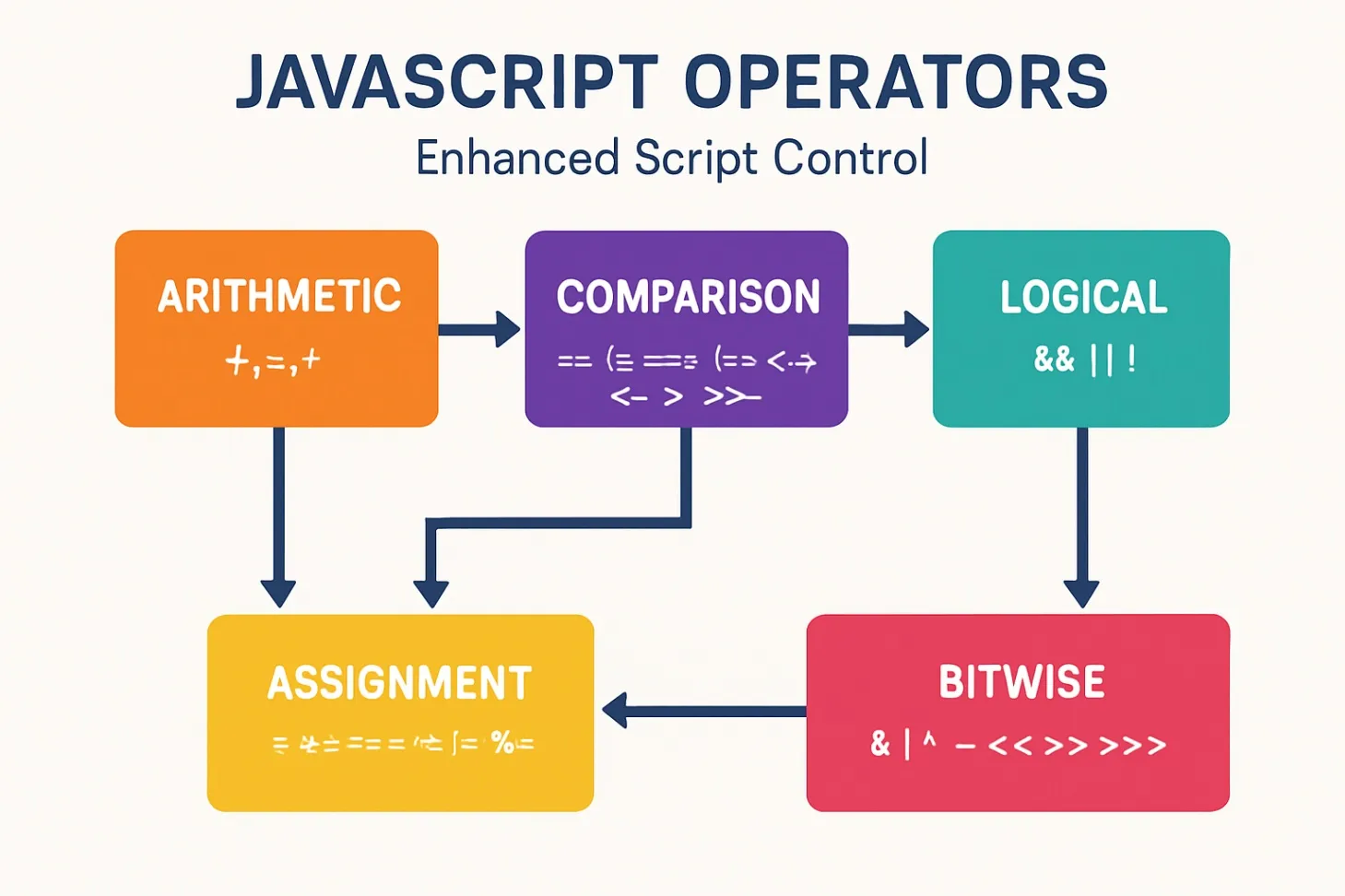
JavaScript operators act as essential components in the programming language, enabling web applications to perform logic and computational operations efficiently. They are not merely tools but integral elements for data transformation and script control. This comprehensive guide aims to demystify the types, uses, and best practices of JavaScript operators, providing insights to leverage them effectively.
Understanding JavaScript Operators
In programming, operators are the connecting points between variables and values, similar to algebraic operations. In the context of JavaScript, they are crucial for calculations and comparisons, allowing developers to create dynamic and interactive web pages.
Core Classification of JavaScript Operators
JavaScript operators can be categorized into several types, each serving distinct purposes:
Arithmetic Operators: Useful for mathematical calculations, these include addition (+), subtraction (-), multiplication (*), division (/), and modulus (%). For example,
let x = 8; let y = 12; let sum = x + y;results in20.Comparison Operators: These allow for value comparisons and include operators like equal to (==), greater than (>), and less than (<). For instance, using
x > yreturnsfalsein the context of the previous variable example.Logical Operators: Operators such as NOT (!), AND (&&), and OR (||) develop compound conditions, enhancing decision structures. An example could be
(x < y && y > 10)which returnstrue.Assignment Operators: These assign values to variables, including the basic assignment (=) and compound assignments like
+=or*=. Utilizingx += yupdatesxto20.Bitwise Operators: Less common, these perform operations at the binary level, which can be useful in low-level programming scenarios.
Crafting with JavaScript Arithmetic Operators
Amongst all operators, arithmetic operators are often most utilized. Understanding their nuances is essential. The addition operator (+) not only sums numbers but also concatenates strings, so developers must be wary of type coercion. Contrarily, division (/) should be carefully used to avoid errors, like division by zero, that could disrupt flow.
Example and Caution: Given let a = "10"; let b = 2; let result = a + b; results in "102" instead of 12 due to string concatenation. Employing type verification before operation prevents such unintended outcomes.
Enriching Code with Best Operator Practices
Mastering JavaScript operators involves strategic application to enhance code efficiency and readability. Consider these practices:
- Type Checking: Verify data types before operations to prevent coercion. Employ
===for strict checks to avoid automatic type conversion. - Explicit Parentheses Use: Enhance clarity and prevent logical errors by using parentheses to clearly define operation precedence.
- Readable Code: Descriptive variable names and consistent formatting simplify complex operations and improve maintainability.
Expanding Your Script Mastery
Understanding and utilizing JavaScript operators effectively can significantly elevate your coding skills. Have you implemented operators in innovative ways to enhance functionality or efficiency? Share your experiences or delve deeper into operator-related documentation and see how you can further enhance your coding expertise.